I've finally started work on my artist book for no-isbn. I've chosen the title the object and eternity. It's a little pretentious maybe but the subject matter will be fairly academic so I think it's fair enough. This Dissertation will form the basis of a series of exhibitions i'll hopefully be holding in the new year.
I finally visited the Book Art Bookshop and had a proper look. It's wonderful in there and the lady who runs it is lovely. I dropped off a few copies of village pub cinema, about which she commented 'now this is the kind of thing that sells'. That made me blush. So you can buy my work there for £3 a go.
While a was looking for photos in my portfolio to add to my new flickr thing, I found some really old work that I kind of still liked.
royal
festival
hall
It's a display type I made in celebration of the Royal Festival Hall. I made it by burning away a stencil of a classical typeface so that something new emerged. This was a tribute to the way in which the new, modern Southbank centre emerged from the destruction of the Southbank during the second world war. The typeface was called tonic, I believe, as in 'a tonic for the the nation'. I just thought I'd post it since I've been talking about that bit of the world a lot recently
A friend of mine was telling me about Lo-Fi architecture and how he’d like to learn more about it. The outline he gave was that it has to do with the re-interpretation of an existing space that has had a previous function. This made me think of a few things: Lo-Fi culture in general, John Ruskin and the Tate Modern.
When I visit the Tate modern, I am struck by the beauty of the shell of this old power station. Something about the fact that it is made of brick and is at the same time so enormous makes it extremely powerful, even aw inspiring. This enormous, utilitarian structure is perfect to hang the new glass fittings and pure, white art gallery walls, seemingly just squatting in the huge space.
-->
Then I think of Ruskin’s criticism of these old factory buildings: De-humanising, impersonal, vulgar affronts to art and architecture. Ruskin’s architectural philosophy valued the natural growth of structures as they adapted to fulfill their latest requirements. He heartily disapproved of the Victorian building practise of hastily fabricating the grandest structure possible, always looking ahead at the next rung on the ladder, without ever glancing back at what has been left behind. This Attitude, I believe, is in agreement with the Lo-Fi philosophy.
-->
Lo-Fi is a combination of the use of any available resources to create (among other things) art, film and music that is accessible and attainable to all and the deliberate use of low-tech solutions to creative problems. The latter principle is, in many ways, a protest against the exclusivity of cutting edge software and technology. However, it is also, in its own right, a celebration and appreciation – a ‘rediscovery’ if you like - of the technologies humanity has developed and discarded in the name of progress. It is a re-humanising of formerly impersonal tools of industry.
-->
This is why the Tate is so beautiful. It is a perfect example of Lo-Fi architecture. What was once a faceless, uncaring, industrial monolith has been reincarnated as a housing of art and culture. It is a celebration of humanity, rather than a destroyer of it. In agreement with Ruskin’s arguments, this building, though at the time it had seemed ready made for its ultimate purpose, has grown into a new structure. One I think he would have been most pleased with.
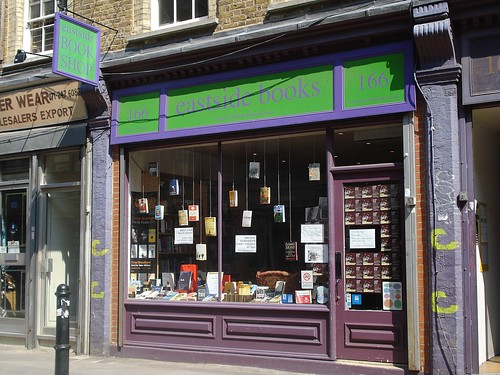
If you're in Brick Lane any time soon, how about dropping into the eastside bookshop and buying one of my hand-printed calendars? They are 630x1050 and rrp for £35. Hopefully over the next couple of weeks they'll be in a few other bookshops.
In an article I wrote for food chain, I made an assertion about time that I would like to expand upon here. The assertion was that, with the globe all but explored and linked in communications networks, allowing anyone to effectively 'be' anywhere, the past is the only unexplored continent.
Time before, say, the twentieth Century, though accessible is far more remote that time after it. The information is not necessarily the click of a mouse away. A plan of research is often required to find specific data. The preparations made to retrieve a piece of information start to look a lot like those made by arctic explorers. Time is an intellectual construct and researchers are the new, intellectual explorers, trawling through archives and museums and censuses. The information is generally housed in single locations that, though physical, are designed and archived in much the same way as a digital network but sometimes this exploration even bleeds into the physical with the excavation of archaeological sites.
I argue that, to an ever-increasing degree, objects and customs we are presented with from distant historical locations appear far more alien to us than any of those presented to us from distant geographical locations.


 lino cut for the front cover of my artist book


 Posts
Posts